

 Het was een schok om weer eens een artikel van John – pardon, dr John – Sullivan in het wild tegen te komen. In een grijs verleden heeft mijn blogcollega Annemarie Stel regelmatig puntige blogs geschreven over John Sullivan, die zichzelf als volgt afficheert:
Dr John Sullivan is an internationally known HR thought-leader from the Silicon Valley who specializes in providing bold and high business impact; strategic Talent Management solutions to large corporations
Ik was in de veronderstelling dat deze thought-leader op zijn lauweren aan het rusten was, maar niets blijkt minder waar. De man schrijft zich nog altijd een slag in de rondte. Voor wie op zoek is naar zorgwekkende soundbites over recruitment: Dr John Sullivan. Ik raad daarbij altijd aan om een artikel eerst even kort door een LLM te halen, om te voorkomen dat je teveel tijd besteed die je nuttiger had kunnen aanwenden.
Ik heb mijn eigen advies natuurlijk ter harte genomen toen ik struikelde over zijn laatste artikel: Pay To Apply… And Other Ways To Discourage Spam Job Applications From AI Agents. Ik heb daarbij de volgende prompt gebruikt: Geef me een grondige evaluatie van bijgaand artikel met speciale aandacht voor de usability van sollicitanten. Mijn huidige favoriet (Gemini) gaf me deze samenvatting: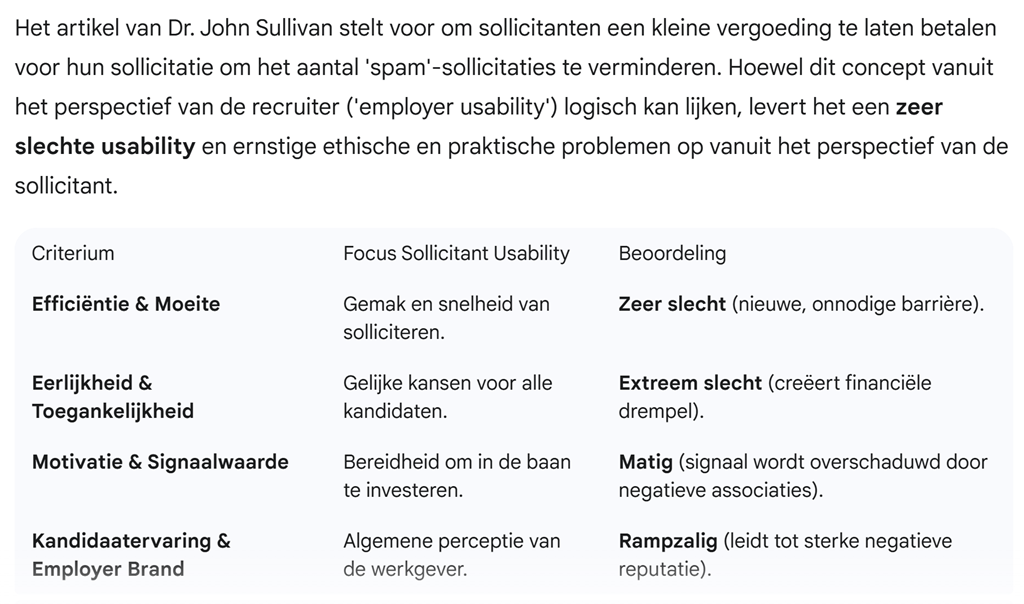
Evaluatie van het ‘Pay to Apply’-model op Sollicitant Usability – Gemini
Ik heb een half jaar geleden nog een blogje besteed aan dit onzalige idee: Een betaalmuur voor sollicitanten?. De Pay to Play (P2P) variant voor het recruitment domein is daarmee wel afdoende afgeserveerd, er is wat mij betreft niets wat ik aan Gemini’s vernietigende oordeel toe zou willen voegen. Maar Sullivan heeft meer dan alleen het pay to apply alternatief beschreven in bovengenoemd artikel (een gegeven dat Gemini om volstrekt onduidelijke redenen volledig heeft overgeslagen…):
If you’re curious, the five most effective ways for discouraging applications are: pay to apply, limiting the number of applications per month, emphasizing employee referrals, bypassing the “quick apply” feature on major job boards, and adding an “I am not a robot” verification process.
Laten we deze eens één voor één kritisch laten beschouwen door Gemini:
2. Limit the number of applications that can be submitted each month
You don’t have to be a recruiter to realize that when a company places a fixed limit on the number of applications (i.e., 2) that it can receive from a candidate during a one-month period. This restriction would take away much of the value offered by spamming AI agents. But to be effective, this restriction on applications would have to be reinforced by a penalty. Like one that would automatically eliminate all submitted resumes from a candidate who violated your restriction on too many or AI-generated resumes.
De evalutie van Gemini laat aan duidelijkheids wederom niets te wensen over: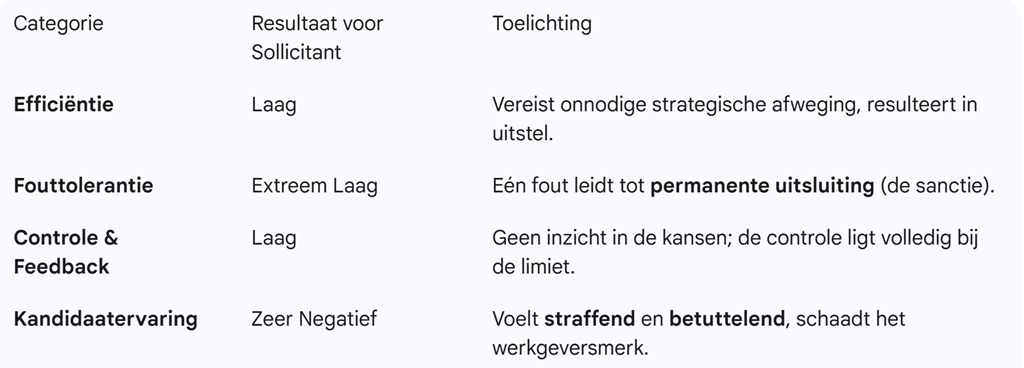
3. Reduce your spam application volume by emphasizing employee referrals
Research has revealed that referred candidates have the highest probability of getting an interview and being hired of all sourcing channels. And that means that employee referral applicants are measurably superior candidates to those sent out by AI agents. That is why many companies assign a priority to assessing employee referrals. Employee referrals are also superior candidates because they have already been prescreened by one of your employees. And their application is likely to be targeted specifically to your company. Fortunately, there is almost no chance an employee referral would be a spammed application.
En om te laten zien dat het niet allemaal kommer en kwel is, hierbij Gemini’s superlatieven: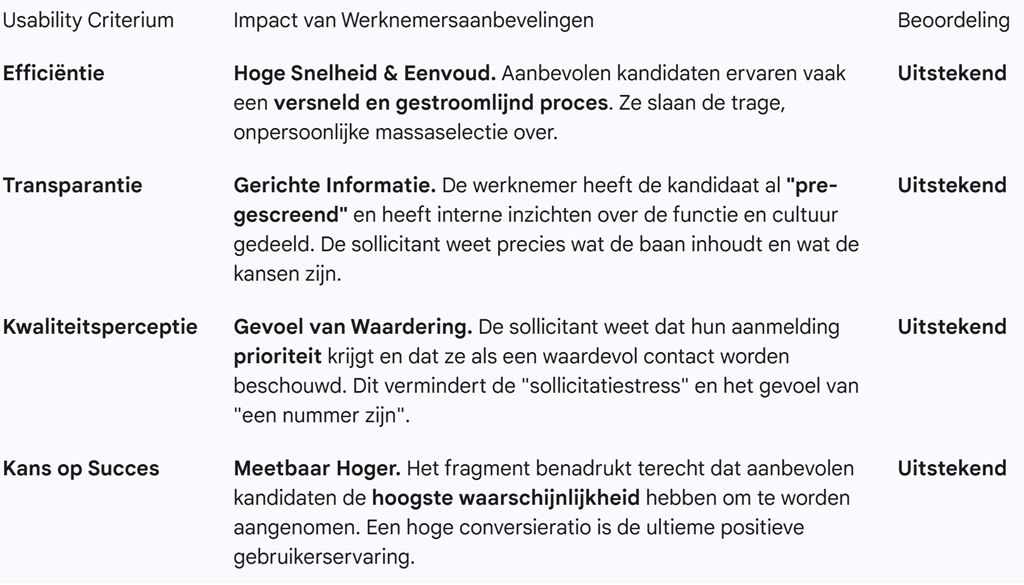
4. Limit postings on job boards that offer “easy apply” features
Today, several large job boards (LinkedIn’s Easy Apply and Indeed’s Quick Apply come to mind) offer applicants an in-house AI agent that, with one click, can send out multiple job applications to the jobs on that job board. As a result, some argue that a company can reduce the number of its spammed job applications that it receives. They can do this by not posting their open jobs on a job board with these embedded AI agent features. Or by proactively not making your open jobs eligible for this one-click, easy-to-apply feature.
Geen blij gezicht bij Gemini dit keer: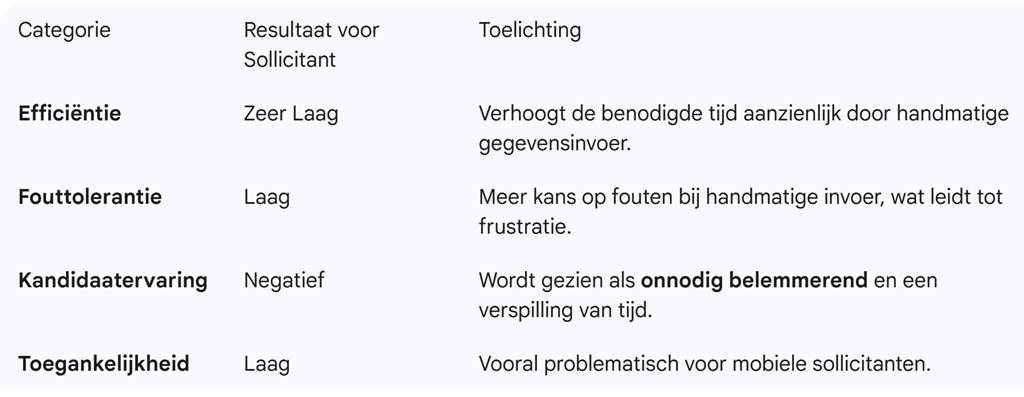
Los van het begrijpelijke gebrek aan enthousiasme geeft Sullivan in zijn argumentatie aan dat LinkedIn en Indeed met één klik meerdere sollicitaties kan doen. Nou kunnen LinkedIn en Indeed bepaald de in hun user journey de nodige tekortkomingen worden verweten, maar niet dat ze een mitrailleur sollicitaties toestaan.
5. Require applicants to complete the “I am not a robot” feature
Long ago, even non-recruiting websites realized they needed a “sign-up feature” prohibiting robotic web crawlers from completing an application process. So by adding one of these “I’m not a robot” checkbox features (Google has a dominant one, reCAPTCHA), the software program judges the visitor’s actions before and after checking the checkbox to determine if the visitor is a person or a robot. And of course, we’ve all experienced the related multiframe “crosswalks” picture model that requires the visitor to pick out each of the frames containing certain images (i.e., a bus).
En een terechte mixed bag als beoordeling:
Ik heb me in het verleden regelmatig vernietigend uitgelaten over de luiheid van websitebouwers op dit punt. Misschien geeft Shit user story: CAPTCHA dit nog wel het beste weer.
Op zich zijn de 5 suggesties van Sullivan geen van allen als providing bold and high business impact te betitelen, maar 4 van de 5 zijn bepaald beschadigend voor de repatie van een werkgever. Een score van 20% lijkt me aan de (zeer) lage kant, tenzij je natuurlijk werkzoekers zoveel mogelijk van je wilt vervreemden. In dat laatste geval is het go, go, go!
Met een beetje sturing is er van een LLM overigens nog best een geinige ux analyse tool te maken. Maar dat is een onderwerp van een volstrekt andere blog posting.